Selected work
Product Design Case Study · Multidisciplinary System · AI-Enabled Practice

Happy Path Studios

Designing a studio where digital products, brand systems, and physical production stay connected from concept to finished experience.

Happy Path Studios grew from a design and development practice into a multidisciplinary product studio spanning UX, software, accessibility, AI-enabled development, branding, hosting, and physical fabrication. The challenge was not simply offering more services. It was creating a coherent way of working across mediums so that strategy and design intent could survive the journey from idea to software, website, signage, apparel, or physical product.

Role

Founder · Product Systems Lead · UX · Front-End Architecture

Contribution

  • Business / Product Strategy
  • Product Vision
  • UX Strategy
  • Brand Direction
  • Experience Architecture
  • Web Design
  • Software Product Design
  • Design Systems
  • Accessibility
  • AI-Enabled Development
  • Content Strategy
  • Fabrication Direction
  • Physical/Digital Experience
  • Production Direction
  • Implementation Validation
  • Portfolio Strategy

The Happy Path Studios homepage: Central Florida · Fabrication · Platforms · Compliance · AI, in one line.

01 — The Problem

Great experiences often break when the work crosses vendors.

A company may hire one studio for branding, another for the website, another for software, another for accessibility, and another for signage or apparel. Every handoff between them is an opportunity for brand drift, accessibility loss, production misunderstandings, inconsistent decisions, and slower iteration.

Happy Path Studios developed around a different question.

What if the same design intent could survive the entire journey from concept to production?

02 — The Studio as a System

The company itself became a product-design problem.

Four disciplines, one production relationship. These are capabilities inside one system, not disconnected departments handing work to each other.

Engineering

Digital Systems

Web development and UX design for organizations where the website is operational infrastructure — including accessibility compliance (WCAG 2.1, Section 508, ADA Title III) for healthcare, federal, and enterprise clients with real documentation requirements.

Fabrication

Physical Production

In-house fabrication covering UV textured printing, fiber and CO2 laser engraving, DTG apparel printing, sublimation printing, embroidery, vinyl cutting, and FDM and resin 3D printing. The same shop that designs the signage produces it.

Software

SaaS Platforms

Twenty in-house platforms covering social scheduling, push notifications, behavioral analytics, QR infrastructure, review aggregation, AI workflow systems, accessibility monitoring, and client portal infrastructure.

Integration

Connected Infrastructure

QR-connected physical surfaces that update from a dashboard without reprinting, managed hosting environments, and AI-assisted workflow automation running behind content, communication, and reporting.

How the Capabilities Connect

Entry Layer

Client Operations

Event operators, accessibility clients, venue operators, and service customers who engage through HPS platforms.

SaaS Platform

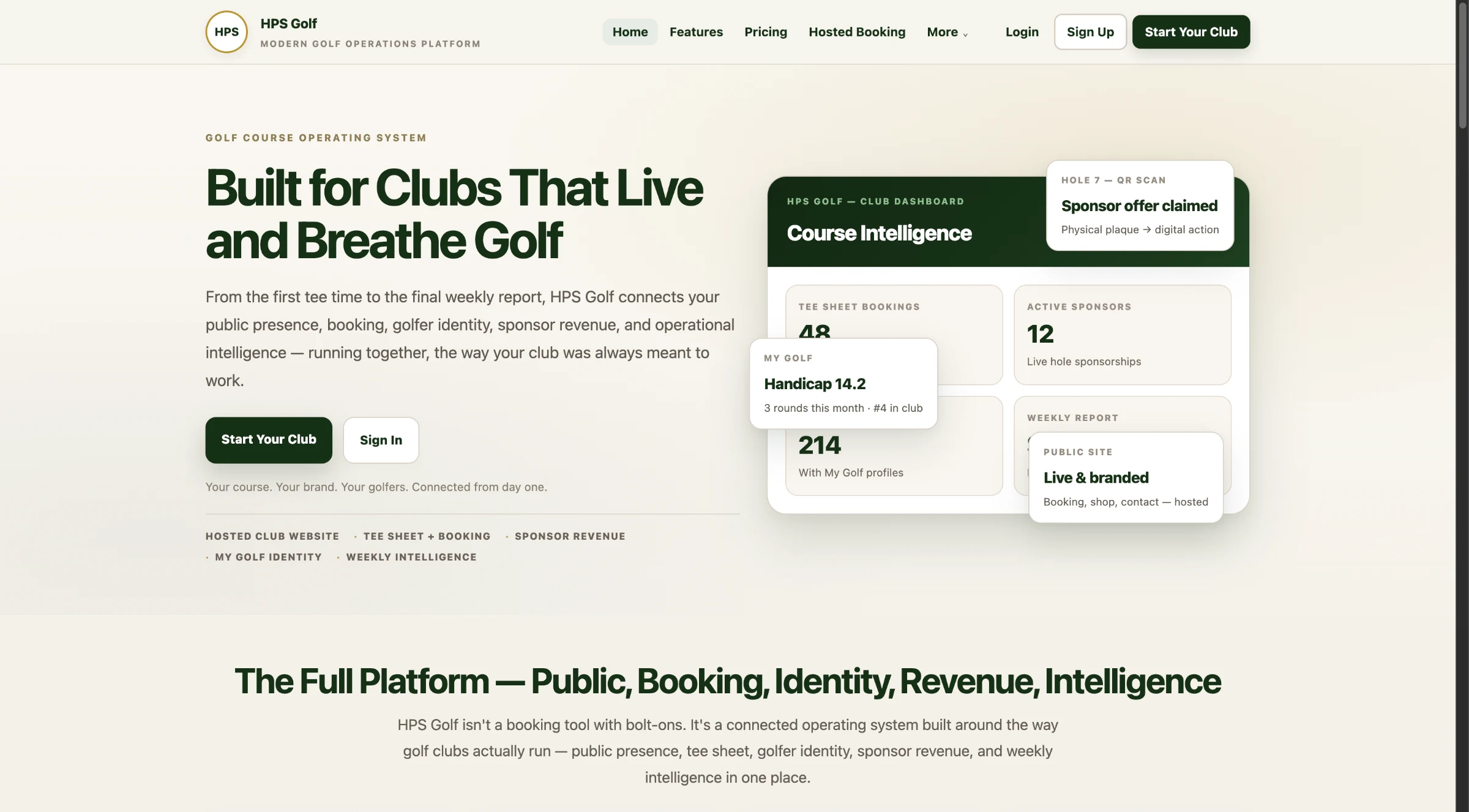
HPS Golf

Tournament and event operations: tee sheets, sponsor systems, QR infrastructure, on-course analytics.

Service Layer

Accessibility Services

WCAG 2.2, ADA, and Section 508 audit, remediation guidance, and design system integration.

Automation Platform

Marketing Systems

AI-assisted content generation, trigger-based campaign delivery, and multi-channel distribution.

Engagement Infrastructure

QR Systems

Code generation, routing, and analytics for physical engagement surfaces.

Production Pipeline

Physical Fabrication

Signage, sponsor surfaces, and QR print production, connected to the platform data model.

Reporting Layer

Analytics & Reporting

Cross-platform performance: event metrics, sponsor engagement, client-facing outputs.

Workflow Orchestration

AI Workflow Systems

Documentation synthesis, content generation, and reporting automation via Stitch and Antigravity.

Shared Data Model

Operational Intelligence

Cross-platform records connecting sponsor configuration, QR routing, fabrication specs, and analytics.

Technical Foundation

Hosting Infrastructure

Self-managed infrastructure via Olares: local model hosting, storage, and controlled-hardware tooling.

Key Operational Connections

Sponsor → QR · Print · Analytics

Configuration set once in HPS Golf flows to QR routing, fabrication specifications, and post-event analytics without re-entry.

AI Workflows → All Platforms

Documentation, content generation, report synthesis, and client communication: throughput infrastructure across every operational context.

Shared Data Model → Fabrication

Physical production specifications derive from the same record as digital deployment. Physical outputs cannot be patched after installation.

Accessibility Services → Platform Development

The service layer is informed by the same practice that builds accessible interfaces; practice and service are not separate disciplines.

03 — One Design Idea, Many Surfaces

A design decision should survive the medium.

The medium changes — pixels, fabric, acrylic, wood, metal, vinyl, print, 3D material — but the underlying design principles remain: hierarchy, legibility, brand, accessibility, context, and production constraints.

  1. Brand Idea

    The identity, voice, and visual language a decision needs to express.

  2. Website

    The idea rendered in pixels, navigation, and content hierarchy.

  3. Software

    The same identity carried into a working product interface.

  4. Signage

    The idea produced in acrylic, wood, or metal, on site, at scale.

  5. Physical Surface

    Apparel, print, or a fabricated object a person actually holds or stands near.

The medium changes. The design responsibility doesn’t.

04 — The Website as the Front Door

The HPS website needed to explain a company that did not fit neatly into one category.

The site had to communicate product design, development, accessibility, applications, hosting, and fabrication without becoming an overwhelming list of services. It positions the studio as operational infrastructure — built to run, not just delivered — rather than a menu of disconnected offerings.

Breadth

vs.

Clarity

The studio genuinely spans product design, software, accessibility, AI-enabled development, and physical fabrication. Explaining all of it at once risks explaining none of it clearly.

Resolution

Organize the studio around understandable capability areas and business outcomes rather than exposing the entire internal toolkit at once.

05 — Product Design Inside the Studio

Happy Path Studios became a place to build products, not just client deliverables.

HPS Accessibility, HPS Golf, and HPS Shalom — each documented as its own case study elsewhere in this portfolio — are not isolated projects. They are evidence of the same reusable product thinking applied to genuinely different problems: enterprise compliance reporting, a physical/digital golf platform, and a cultural editorial and commerce ecosystem.

The studio became the environment where a new product concept could move from idea to working software without waiting for a separate engagement to be scoped and sold.

06 — AI Changed the Operating Model

AI did not replace the studio. It changed how far the studio could travel.

Before AI-Enabled Development

IdeaResearchDesignHandoffDevelopmentReview

That workflow still applies to a great deal of the studio’s work. Increasingly, it now runs alongside a shorter loop.

AI-Enabled Workflow

  1. Idea

    A product or business problem worth solving.

  2. Frame

    Define the boundaries of the problem before any interface exists.

  3. Design

    Structure the experience and interaction model.

  4. Functional Prototype

    Build something that behaves like the real product.

  5. Implement

    Move the validated interaction into working software.

  6. Experience

    Use the actual product to evaluate the decision.

  7. Critique

    Judge the result against intent, not against effort spent.

  8. Iterate

    Adjust based on what the working software revealed.

AI-assisted development and workflow automation — including Claude and n8n-based automation running behind content, data enrichment, and operational intelligence — can accelerate research, exploration, functional prototyping, implementation, refactoring, and QA support. Product judgment, architecture, brand, UX, accessibility, priorities, and acceptance remain human responsibilities.

AI expanded the studio’s capacity. It did not replace the studio’s judgment.

07 — The Lesson From AI-Generated Output

More production capacity created a greater need for editorial judgment.

AI can generate more screens, more code, more content, more options, and more features. That does not automatically create better hierarchy, better product strategy, better UX, better accessibility, better brand, or better business value.

Turning Output Into Coherent Work

  • Critique
  • Editing
  • Consolidation
  • Standards
  • Frameworks
  • Testing
  • Validation
  • Deletion

More output is not the same as more value.

08 — Accessibility as a Cross-Medium Discipline

Accessibility does not stop at the browser.

WCAG 2.1, Section 508, and ADA Title III compliance for healthcare, federal, and enterprise clients is core to the studio’s digital-systems work. That same thinking — legibility, contrast, clear communication — extends to where accessibility naturally applies across mediums:

Where Accessibility Thinking Applies

  • Websites
  • Applications
  • Digital Content
  • Forms
  • Navigation
  • Documents
  • Physical Signage
  • Wayfinding
  • Legibility
  • Contrast

Accessibility is not a digital afterthought. It is part of how the experience is made.

09 — Fabrication Changed the Design Conversation

A file on a screen behaves differently when it becomes a physical object.

Physical production introduces constraints a screen never enforces: material, size, viewing distance, durability, surface, color reproduction, engraving and print behavior, and installation environment. Having that production capability in-house changes the feedback loop. Instead of designing, sending the file away, waiting, and discovering a production problem later, design and fabrication sit next to each other.

From the HPS Golf pilot: the same in-house fabrication capability, documented on site rather than staged.

  1. Design

    Branding, layout, placement, and content architecture.

  2. Fabricate

    UV print, laser engrave, or vinyl-cut the physical surface in-house.

  3. Inspect

    Check the produced object against the original design intent.

  4. Adjust

    Correct what only becomes visible once the object is real.

  5. Reproduce

    Repeat the same production relationship as it scales.

10 — Designing Across Digital + Physical

The same brand can exist in code, fabric, acrylic, print, and space.

A Documented Example

A tee marker is laser-engraved on site. The QR code embedded in it routes to a destination the studio controls.

Same team, same building, physical and digital unified — the course branding, hole layout, sponsor placement, and QR content architecture are designed once, then produced in-house by UV printing, laser engraving, or vinyl-cutting the physical surface.

11 — The Application Ecosystem

Reusable product thinking created a portfolio of digital products.

Twenty in-house platforms, organized by operational function rather than built as one flat list. The studio repeatedly applies common product and design patterns while letting individual products retain distinct jobs and audiences.

Accessibility & Compliance

  • HPS Accessibility

Vertical Products

  • HPS Golf
  • HPS Shalom
  • HPS QR Code

Creator & Media

  • HPS Creator Hub
  • HPS Media Studio
  • Creator Hosting
  • HPS Transfer
  • FreeBeatsMUSIC

Marketing & Growth

  • HPS Socialize
  • HPS BioLinks
  • HPS Push
  • HPS SocialProof

Analytics & Observability

  • HPS EngageTracker
  • HPS SEO Audit
  • HPS Uptime

AI & Operational Intelligence

  • HPS AI Systems

Reuse the system. Not the product.

12 — Frameworks Instead of Repeated Work

Repeated problems should become systems.

Twenty platforms sharing the same operational needs — a front-facing marketing presence, analytics, accessibility monitoring, client portal infrastructure — do not each deserve a one-off solution. Organizing the ecosystem into capability clusters was itself a design-systems decision, applied at a product-portfolio level rather than a single interface.

The value is not technical elegance for its own sake. It is consistency, faster iteration, shared accessibility, a shared design language, and less drift as the ecosystem grows.

13 — The Business Model as a Design Constraint

A studio has to design for business reality too.

Product and design decisions had to account for cost, repeatability, maintainability, sales clarity, delivery, and customer value — not only what was interesting to build.

Custom Work

vs.

Reusable Products

Every client engagement could be treated as bespoke from scratch, or the studio could build once and adapt.

Resolution

Reuse shared foundations and frameworks across engagements while keeping client-facing identity distinct.

Digital Services

vs.

Recurring Software

Project-based delivery ends at launch. Software platforms need ongoing operational relationships to stay valuable.

Resolution

Design engagements as operational relationships rather than one-time deliverables, wherever the work supports it.

One-Off Fabrication

vs.

Repeatable Production

A single sign is a project. A production relationship across many surfaces is a system.

Resolution

Build fabrication workflows that can repeat and scale rather than treating every physical object as a one-time job.

14 — Product Decisions & Tradeoffs

Six tensions ran through the studio itself.

Breadth

vs.

Clarity

The studio can do many things. The customer experience still has to explain them in a way that remains understandable.

Resolution

Present the studio through coherent capability groups rather than exposing every tool and service equally.

Speed

vs.

Craft

AI and reusable systems can accelerate execution dramatically. Speed alone does not guarantee the result is good.

Resolution

Use AI and reusable systems to accelerate execution while maintaining human review over hierarchy, brand, UX, accessibility, and production quality.

Reuse

vs.

Custom Experience

Shared foundations make the ecosystem maintainable. Every product and client still needs to feel like itself.

Resolution

Standardize foundations and frameworks while allowing products and client work to retain appropriate identity.

Digital

vs.

Physical

Software and fabrication have historically been run as separate businesses by separate vendors.

Resolution

Treat them as different mediums inside the same design system rather than unrelated businesses.

Automation

vs.

Judgment

AI-assisted development and workflow automation can absorb real repetitive work. Not every decision should be automated.

Resolution

Automate repetitive production and implementation where valuable while keeping consequential creative and product decisions human.

Capability

vs.

Positioning

A studio that can do everything risks sounding like it stands for nothing in particular.

Resolution

The studio can do many things, but the customer experience must explain them in a way that remains understandable.

15 — How I Work Now

My role increasingly spans the distance between strategy and reality.

A background across UX, front-end development, accessibility, visual design, and production lets me move between layers rather than treating them as handoff boundaries. That is not a claim of equal specialization in every technical discipline — it is system-level understanding and ownership across digital, software, AI-assisted, and physical mediums.

  1. Understand

    The business or product problem before any interface exists.

  2. Frame

    What actually needs to be true for the work to succeed.

  3. Design

    Structure and interaction across whatever medium the problem needs.

  4. Prototype

    Something concrete enough to evaluate before committing further.

  5. Build

    Working software, implemented rather than only specified.

  6. Produce

    Physical fabrication, in-house, from the same design intent.

  7. Validate

    Check the result against the original problem, not just the brief.

  8. Iterate

    Refine as digital and physical reality reveal what the screen couldn’t.

I don’t want design to stop where the next discipline begins.

16 — What I Personally Owned

The studio became an extension of how I think about product design.

Company Vision
Product Strategy
UX Strategy
Experience Architecture
Brand Direction
Web Design
Software Product Design
Design Systems
Accessibility
AI-Enabled Development Direction
Content Strategy
Application Portfolio Strategy
Physical/Digital Experience
Fabrication Direction
Production Review
Implementation Validation
Business Positioning
Iteration

The studio is a collaborative practice, not a one-person operation. But the responsibility for keeping vision, design, and production coherent as the ecosystem grew was mine.

17 — Outcome

The result is not one product. It is a connected way of making products.

  • Multidisciplinary studio architecture established
  • Digital presence spanning products, services, and positioning
  • Multiple HPS software products shipped (HPS Accessibility, HPS Golf, HPS Shalom, HPS QR Code, and others)
  • Twenty in-house platforms organized into coherent capability clusters
  • In-house accessibility practice, WCAG and Section 508 aware
  • In-house physical fabrication capability: laser, print, embroidery, 3D production
  • AI-assisted, automation-supported operational workflow
  • Design-to-production continuity across digital and physical mediums

The key outcome is methodological. Happy Path Studios became a system for moving ideas through multiple mediums without repeatedly losing product intent at handoff boundaries.

The most important handoff to eliminate is the one where the original intent gets lost.

The future of product design is not about staying inside one discipline. It is about staying responsible for the experience as it moves across them — digital, physical, operational, brand, and product, together.

Continue Exploring

The studio’s philosophy, in a single connected product.

HPS Golf

A 0→1 golf-course platform connecting course operations, golfer experiences, QR-enabled physical touchpoints, sponsorship, and analytics.

The clearest single embodiment of this studio’s philosophy in practice: one connected system spanning software, AI-assisted development, and real, in-house physical fabrication.

  • Physical/Digital
  • 0→1 Product
  • AI-Assisted Development