HPS Product Framework
A reusable product foundation for Happy Path Studios, applied through one focused product, Plantation Paw Prints.
Era
Ongoing
Role
Product Strategy · UX · Platform Architecture · Development
Platform
Reusable Application Foundation · Product Infrastructure
A reusable foundation for building focused products.
The HPS Product Framework is a reusable application foundation developed at Happy Path Studios. It exists to reduce the repeated work of rebuilding common product infrastructure every time a new focused product is created.
It is not a single application and not a product on its own. It is the shared architecture that other Happy Path Studios products, including Plantation Paw Prints, are built from.
Reuse where it creates leverage. Stay specific where it does not.
The framework is not built around maximum abstraction. Architecture is shared across products only where that reuse creates meaningful leverage: proven patterns that already work, applied again instead of rebuilt from nothing.
Every product still keeps its own behavior and experience specific to its own audience and operational need, wherever generalizing that experience would add complexity the product does not actually require.
Reusable capability areas, not a fixed product shape.
The framework provides reusable patterns across a defined set of capability areas: content management, media, authentication, permissions, commerce, payments, administration, orders, fulfillment, operational workflows, and deployment.
A new product draws only on the capability areas it actually needs. No product is expected to use every area, and the framework does not assume otherwise.
Capability Areas
- Content Management
- Media
- Authentication
- Permissions
- Commerce
- Payments
- Administration
- Orders
- Fulfillment
- Operational Workflows
- Deployment
One focused product, built on the shared foundation.
Plantation Paw Prints began as a greenfield project and became a working club platform: public content, CMS capabilities, events, a calendar, community features, media management, commerce, Stripe checkout, order tracking, and production and fulfillment workflows, supported by role based administration.
Plantation Paw Prints is one concrete example of the framework applied to a focused product. It does not exercise every capability area the framework provides, and it is not meant to.
A first look at the framework in one real product.
A few representative screens from Plantation Paw Prints. The full visual story, including the complete homepage, continues in the deep case study.
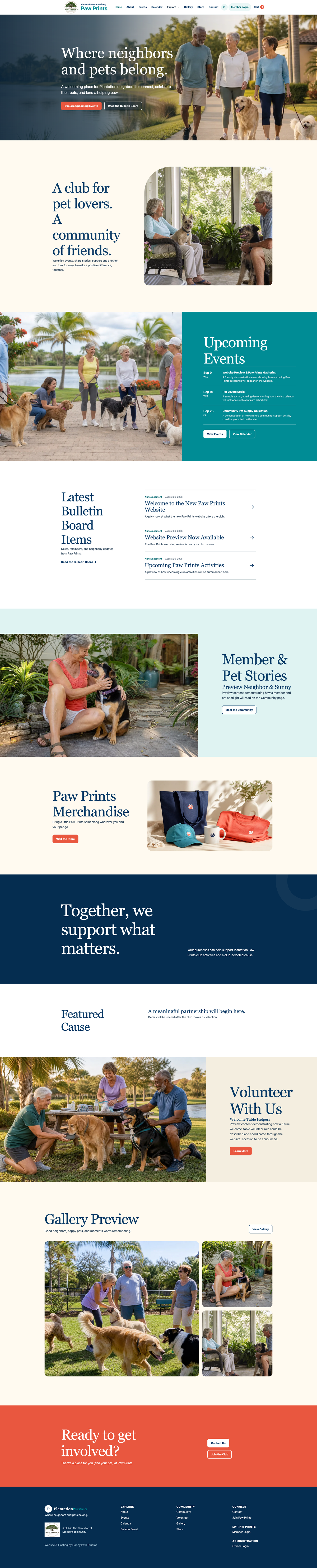
Public Experience
The public facing club experience, built from the shared foundations of the framework.
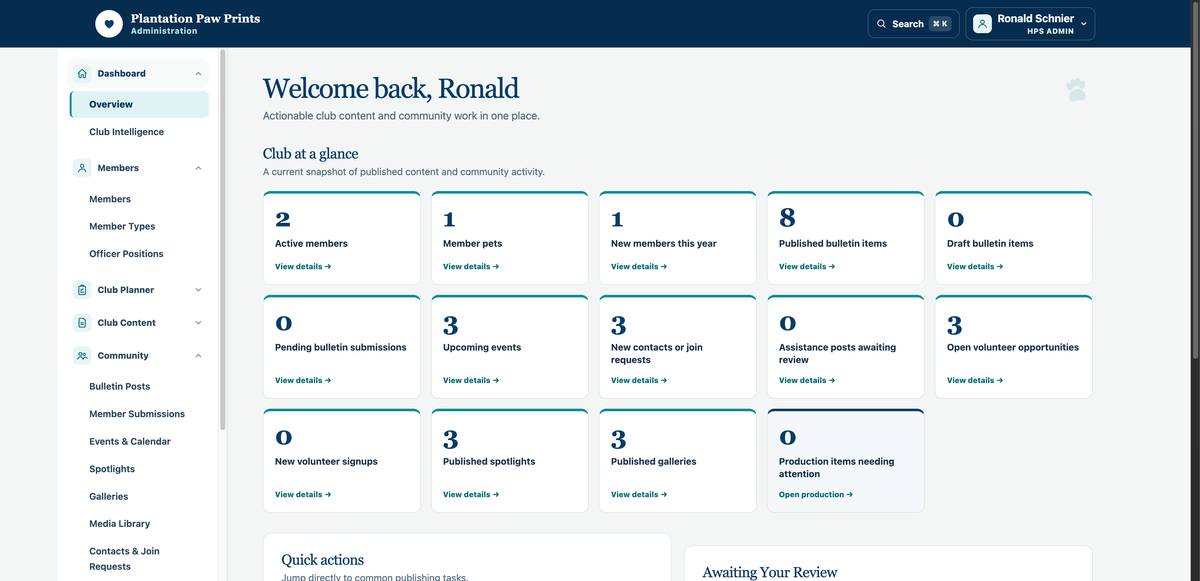
Administration
The operational layer behind the public site: managing members, content, events, and production related work.
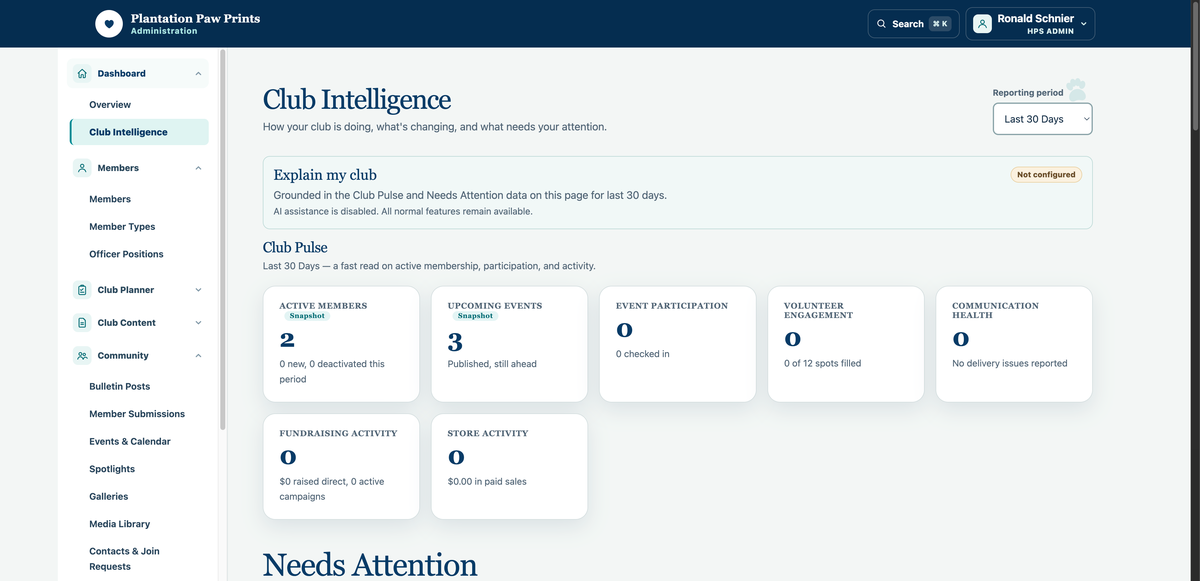
Operational Intelligence
Decision support built on the same shared foundation, not just content administration.
Staying pilot first was the deliberate decision.
Plantation Paw Prints was intentionally kept pilot first rather than being generalized into a multi tenant SaaS product before that need was proven.
Abstraction that has not earned its place adds cost without adding value. The judgment here was not about what the architecture could support. It was about what this specific product actually needed at this stage.
“Generalizing Plantation Paw Prints into a multi tenant SaaS product before that need was proven would have added complexity the product did not yet require.”
Experience the Product
The case study explains the product strategy and design decisions. Now explore the live product yourself.
Visit HPS Product FrameworkA foundation that makes the next focused product easier to build.
The larger value of the framework is not any single product built on it. It is a shared foundation that lets the next focused product start from proven architecture instead of a blank page, without forcing that product into a shape it does not need.